Friday, October 15, 2010

First all-grain - brew in a bag

First all-grain brew in a bag style:


That Sunday's brew session was... interesting :) I knew my drill would lose power half way through the grain bill. I didn't know that my fellow brewer/brother in law's backup drill chuck would be too small... or that my antique hand drill (getting desperate) wouldn't clamp on tight enough... or that my air tool set didn't have an actual drill. At least my father in law, Bill, doesn't live far and he had a super drill!

Drilling and filing the hole for the brewpot valve took longer than I thought as well... of course. At any rate, other than taking awhile, it worked fine - no leaks!

The brew in a bag experience was interesting. My mother-in-law, Terri, did a super job constructing the bag, but I think I had her get the wrong bag material. It didn't want to release any wort. We had to lift out 20 pounds of grain and probably 8 gallons of wort. We let it drain into a separate bucket, but it took a long time and we had to massage the bag a bit (probably extracting too much tannins, especially since it's a dark beer). But... we did end up with about the right amount of wort... and I think we got over 80% efficiency! It tasted good going into the fermenters too. We shall see. I wish it would have been ready by this week's brew club meeting... but it will have to wait for the next meeting, I guess.

Thanks again to Erich for his help and spare parts!


Northern California Homebrewer's Festival (NCHF) 2010

As a member of the Hetch Hetchy Hop Heads homebrew club, I made the trek out to Lake Francis Resort (a campground near Dobbins, CA - northeast of Sacramento, in the boonies). This year had over 20 clubs and over 208 club beers on tap for "the main event". Unfortunately, Sean Paxton, the homebrew chef, was busy at GABF this weekend - so the dinner Friday night was not as spectacular as in years past. Lake Francis did provide some very excellent prime rib, and with plenty of beer, it was a good evening. The Hoppy Hour before Friday's dinner was spectacular as well.

What amazes me the most about this awesome festival is the organization behind it. The Board sure has it figured out by now - everything appears to run like a well oiled machine, powered by homebrewers. It's all a volunteer effort that is incredible to behold. It reminds me of big projects at work - so many moving parts that when it's successful, all the players are working towards a common goal with the priority being the success of the project. Same here - all the clubs work really hard to present their food and beers in a generally well decorated booth. Everyone is very accommodating and friendly. It just makes for a great time and a successful event.

Since I didn't have any beer to bring at the time, my contribution was making pretzels...

Latest House Project - funky remodels

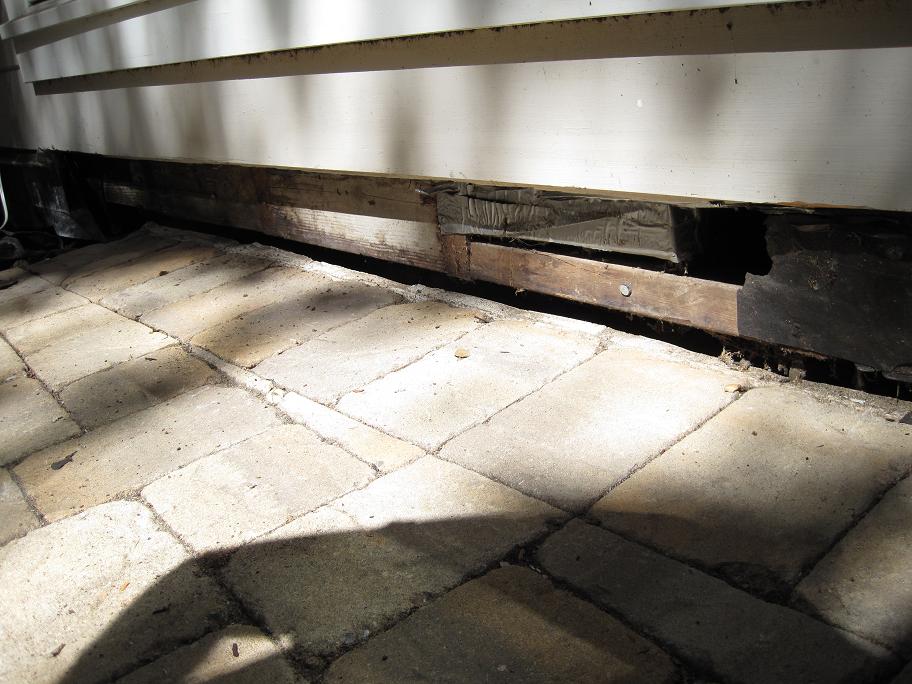
Buying a house that has been remodeled will give you some surprises. A house that has had a remodel on top of an older remodel may really give you a surprise... and most likely not in a good way. While our house's first remodel (from the '50's or '60's?) is weird, it's not terrible on its own. When the second more recent remodel came along with new landscaping, it made for a bad situation.

The warning signs were the dogs sniffing and being obsessed with weird spots around the house. No wonder they use beagles for drug sniffers or hunting dogs! Well, our Moose is a hunter. The project started with Moose catching a rodent. It was living in a gap under the siding, as we found out when we started to take things apart. Other interesting things were found as well - an oddly cantilevered wall, exposed ducting for the HVAC, a small amount of dry rot (did we catch this just in time?!), and more. Without totally rebuilding the wall, we flashed it better and are patching it all back so it doesn't house rodents and doesn't allow water intrusion.

Monday, September 27, 2010

Biking to work - striping ideas

Last Wednesday evening, instead of mountain biking after work, I attended a bike class. This class was put on by Commute.org and taught by John Ciccarelli. I knew John from work, so I was excited to hear him talk - he is a super bright guy.


One thing I took away from the class relates to bike lanes next to parallel parked cars. I have designed striping plans like this, I'll admit. Now that I have biked to work and a short stretch of road includes this striping layout, I don't know that I will implement this design anymore. Riding to work, I am always scared that I will get doored. I try to look at sideview mirrors and through windows to see if anyone is about to get out, but it's almost impossible to tell, especially at 15 mph. John calls this a form of russian roullette. With that analogy, I decided my next ride would not put me at this risk. The solution is to basically ride on the lane line, or along the left side of the bike lane - outside of the door zone.

The problem with this solution is that you're riding closer to the moving cars. I was actually more comfortable with this than I thought I would be - the differential speed is minimal, plus I was super stressed out playing my game of russian roulette. The only other issue is what are the drivers thinking - "hey, this guy's got a 5' bike lane, but he's riding at the very edge next to me... I'll get him and drive real close". I would agree. As a driver, I think things like that.

So, the real solution is to start implementing different striping - don't do the standard 5' bike lane next to an 8' parallel parking space. As I usually do, I had some good ideas in the shower. When I got into work, I did some googling and found these two examples that are pretty much what I was thinking. You have to delineate something that gives direction to the bike of where they should be riding (outside of the door zone), limit the amount of parking area, and give the drivers an expectation of where the bikes should be riding. I like the idea of a wider bike lane with the diagonal stripes in the door zone, myself.

The problem with these solutions, as shown, assume that you have 12', 13', or 18' to work with... and that it's a sufficient amount of space. I would go for the 7' parking lane, but think you would need another 7' (3.5' for door zone, and 3.5' for bikes) for a total of 14'. The trouble is, we're lucky to have 11' or 12' to work with, after narrowing the vehicle lanes. Where do you find the additional 2 or 3 feet?

Other alternatives include sharrows (I think these are too infrequent, hard to see, and too detailed), no striping just a wider lane (this doesn't give the driver an expectation of where the bikes should be, or tell the bikes where they should be), or a bike boulevard with a painted lane (too much maintenance).

Friday, September 24, 2010

Cheese Failure #2 and #3

I finally had a chance to check out the cheeses I made a few months ago. They never looked like they were aging well, so my hopes weren't too high. As I figured, they didn't taste very well. The blue might have been salvagable, but the brie certainly wasn't. Amazingly, the textures were spot-on, though. I guess I should be happy about that.

I didn't take any photos, because they were just too scary. I just dumped them as quickly as I could after cutting into them and taking a small taste of each... then washing my mouth with a bit of tequila to kill any scary stuff! I guess it worked, I'm not sick today. Whew.

I think the mistakes could be attributed to two things: 1. I didn't drain the cheeses long enough after they set, and 2. they got too hot about a week into the ripening stage.

This probably caused: 1. the blue to still be losing moisture after three months, and the molds to not grow properly, and 2. killing off the molds before they really had a chance, and to ripen too quickly too early.

If I am going to be successful with this cheese thing, I really do need better facilities, and better temperature control. Our house is just not set up well for making cheese (or beer, for that matter), and we don't have room for another fridge dedicated to cheese. Funny, our last house had both. Go figure.

Thursday, July 1, 2010

Solar Highway v3.1

Do you ever have your best thoughts during inoportune moments?  For me, it's always in the shower.  Maybe it's all the hot water that gets the brain cells going in the morning, thinking of fresh new things.  Of course, I often wonder if I could ever come up with a new idea - hasn't someone always thought of it before me?  I decided to jot this one down for posterity.

The solar highway.

Or maybe it should be the Solar Highway?  You see, there have been at least a couple different versions thought of before this one.  I did partly get the idea from them, I'm sure.  For reference, here are the ones I've seen:
http://www.oregon.gov/ODOT/HWY/OIPP/inn_solarhighway.shtml
http://solarhighway.org/
http://www.zdnet.com/blog/emergingtech/capturing-solar-energy-from-asphalt-pavements/1010

But here is my idea.  This may be only best applied to ultra urban areas, but then those are the locations that probably need the electricity the most.  Please excuse my poor photoshop skills:
Why not put panels on poles in the median?  There certainly isn't room in the right of way like in rural Oregon, so why not make use of the median and airspace above the vehicles?  I used a call box panel and pole as a template, but more significant structures could be used with many more panels.  I would think this could generate quite a bit of electricity.  It might also reduce the urban heat island effect.

I have heard ideas (in the Bay Area) of using the median and airspace above for a BART line, or high speed rail.  This isn't practical because of the interchanges - the rail line would have to go above the overcrossing.  With such flat slopes for rail, it would basically remain this height for the entire length of the median run - just not practical.  But the solar panels don't need to be continuous.  They could break at the interchanges, so there is nothing higher than the overpasses.

Would this be a minimal enough visual obstruction?  Maybe, maybe not... but it's a thought.  I don't know what business plan would work for this - does the State own them and sell the electricity to the power companies?  Would the power companies build it and lease an easement from the State?  Does it even make financial sense?  Considering all costs, could it be less expensive than coal or nuclear?  Maybe, maybe not.

First real ride of the season

After more than a few rides at Waterdog, I think we were all anxious to go on a "real" ride.  Waterdog is actually somewhat technical and is decent exercise, especially with the newer trails... but it gets old fast.  It's also a little crowded and feels a little urban.  Isn't mountain biking an excuse to get away from the hustle and bustle and out into the wilderness a bit?  We definitely got that at Purisima during this week's weekly ride.  Purisima is a nice ride, and with daylight savings, we can get the 2-hour ride in after work and before dark.  The challenge with Purisima is the 4-mile, 1,400-foot climb at the end.  At an average speed of 4mph, that's a 1-hour constant climb back to the top.  My knee is complaining today!  Hopefully my knee feels better in a day or two, ready for some great rides up in Reno this weekend.
Jason Y., Jason M., and Denise... ready for our 1-hour climb...


Jason M. and Savior appreciating the surroundings...